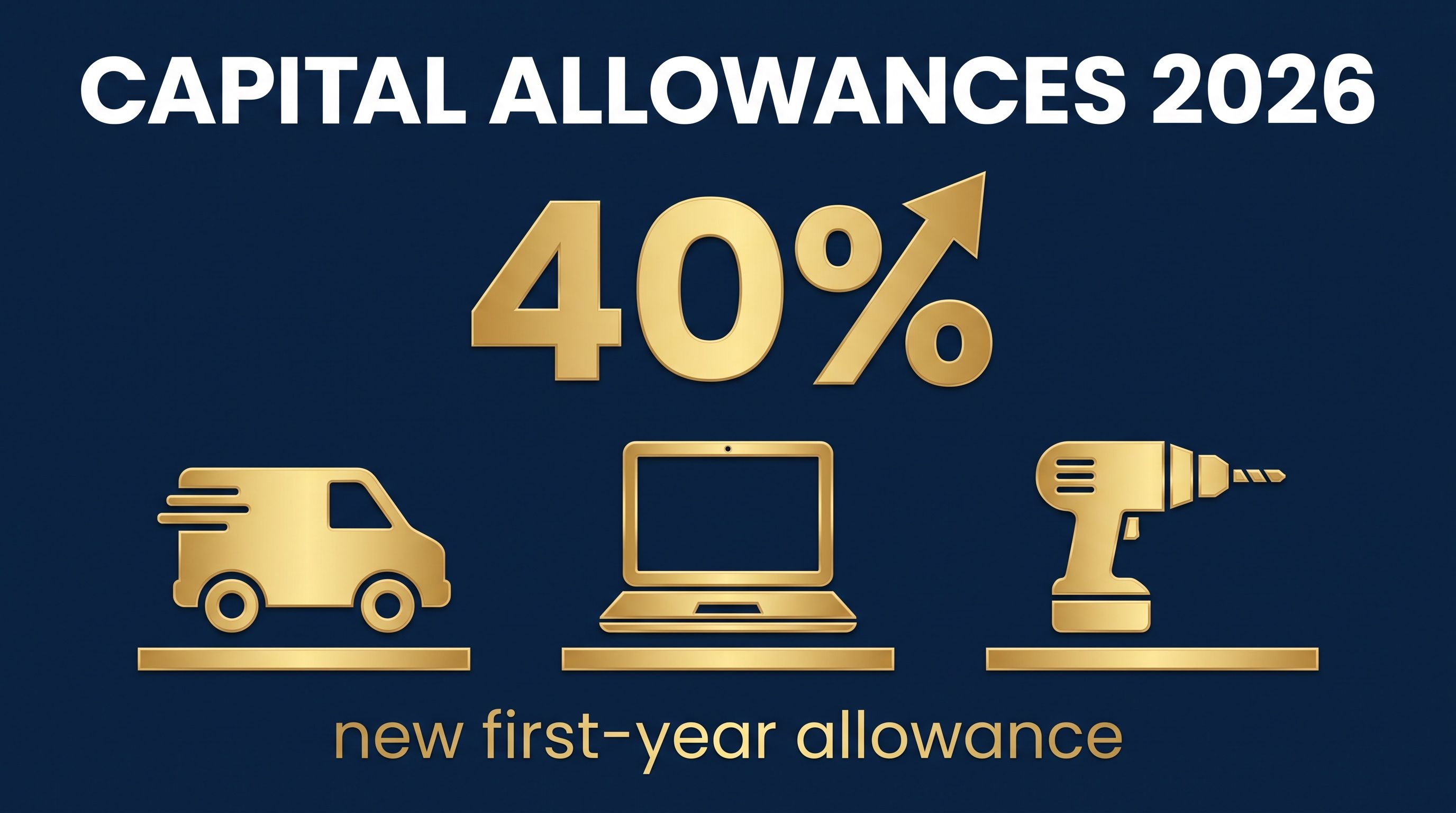
If you buy a van, a laptop or machinery for your business, two changes took effect in 2026 that alter how you get tax relief on the cost. A new 40% first-year allowance applies to qualifying spending from 1 January 2026, and the main pool writing down rate has been cut from 18% to 14%.
Both have been widely reported, and a fair amount of what has been written about them is wrong. The honest summary is that for most small businesses nothing much changes, and the reasons why are worth understanding. Here is what the rules actually say.
In a nutshell
- Capital allowances are how you get relief on equipment. But many sole traders use a different route entirely.
- There is a new 40 per cent first-year allowance. For qualifying spending from 1 January 2026.
- For most small businesses it changes nothing. The Annual Investment Allowance already covers you.
- The main pool rate fell from 18 to 14 per cent. Slower relief, not less relief.
- Cars follow their own rules. Excluded from both the AIA and the new allowance.
- Claiming in the right order matters. Especially where spending is large.
1. What capital allowances are and who uses them
When you buy equipment that lasts, a van, tools, a computer or machinery, you cannot simply deduct it as a running cost in the normal way. Capital allowances are the mechanism that spreads or accelerates the tax relief on that cost.
There is a big exception that catches people out, and it works in your favour. Since April 2024 the cash basis is the default for sole traders and partnerships. If you use it, you cannot claim capital allowances, with cars being the exception. That sounds like bad news but usually is not: under the cash basis you deduct most equipment costs in full when you pay for them. A £3,000 machine is simply £3,000 off your profit that year, which is faster relief than any capital allowance.
So if you are a sole trader on the cash basis, most of this article is background rather than homework. What you lose is the mechanism, not the relief, and moving to the accruals basis is not automatically better.
2. The new 40 per cent first-year allowance
For businesses that do use capital allowances, the headline change is a new 40% first-year allowance on main rate plant and machinery. It applies to qualifying expenditure incurred on or after 1 January 2026.
That date matters, because several write-ups have said it starts on 6 April 2026 for income tax. It does not. The legislation sets a single start date of 1 January 2026 for both income tax and corporation tax. April 2026 is the date for the separate rate cut. In practice a sole trader can already claim it on the 2025/26 return being prepared now, in box 55 of the self-employment pages, for qualifying spending between 1 January and 5 April 2026.
To qualify, the asset must be new and unused, not a car, and not special rate expenditure. Second-hand kit does not qualify. One quirk worth knowing: if you claim the 40%, the remaining 60% cannot go into your main pool in the same period. It joins the pool in a later period. So year one relief is 40%, and no more.
3. Why this probably changes nothing for most small businesses
Here is the part that most coverage skates over. The Annual Investment Allowance remains at £1,000,000 a year, and it gives you 100% relief on qualifying plant and machinery in the year you buy it. Companies buying new main rate equipment also still have full expensing at 100%.
Against a 100% allowance, a 40% allowance is not an upgrade. It is a fallback, and it genuinely matters only in three situations:
- Your spending exceeds the £1m AIA in a year.
- The AIA is not available to you, for example a partnership with a corporate partner, or a company sharing one AIA across a group.
- You bought the asset to lease to a UK business, which the AIA and full expensing do not cover.
If you are a sole trader or a small limited company spending well under £1m, the AIA still does the work and the new allowance will rarely come into play. That is not a disappointing answer, it is the reassuring one.
4. The main pool rate falls from 18 to 14 per cent
The change that does touch more businesses is the cut to the main pool writing down allowance, from 18% to 14% a year on the reducing balance. It applies from 1 April 2026 for companies and 6 April 2026 for sole traders and partnerships.
Be clear about what this does and does not mean. It is not a loss of relief. You still get tax relief on the whole cost eventually, it simply takes longer to come through. It is a cash flow cost, not a lost deduction.
Two practical notes. If your accounting period straddles the change date, you get a blended rate based on the days before and after: a company with a year ending 30 June 2026 lands on 17%. And the special rate pool is unchanged at 6%, so integral features, solar panels and long-life assets are unaffected.
5. Cars follow different rules
Cars are the exception to almost everything above. They are excluded from both the Annual Investment Allowance and the new 40% first-year allowance, so the usual routes do not apply.
What you get depends on emissions. A new and unused zero-emission or electric car attracts a 100% first-year allowance, currently available until 31 March 2027 for companies and 5 April 2027 for income tax, so a purchase decision this year is a real decision. A car at 50g/km or less, including a second-hand electric one, goes into the main pool, now at 14%. A car over 50g/km goes into the special rate pool at 6%. Note that a second-hand electric car gets the main rate, not the 100% allowance.
6. The order that usually gives the most relief
There is no legal order in which you must claim, and you can claim an allowance on part of your spending rather than all of it. But there is an order that usually produces the most relief soonest.
Use your AIA first, and point it at special rate expenditure before main rate expenditure. Special rate items otherwise crawl along at 6% with no fallback, while main rate items have the 40% allowance available if the AIA runs out. After that, use the 40% allowance on qualifying new main rate assets, and let the rest fall into the pools. One more small win: if a pool balance drops to £1,000 or less, you can write off the whole balance instead.
A worked example: two builders
Anna runs a small building company and spends £60,000 in the year on a van, power tools and a compressor, all new. Her AIA covers the lot, so she gets 100% relief on £60,000 in that year. The new 40% allowance never comes into play, and the rate cut does not touch her because nothing lands in the pool.
Now take a larger firm that has already used its full £1m AIA and then spends another £100,000 on new machinery. It claims the 40% first-year allowance, giving £40,000 of relief in that year. The remaining £60,000 does not sit in the pool that year at all: it enters the main pool in the following period and is written down at 14% from then. Before 2026 that balance would have moved at 18%, which is the practical effect of the rate cut.
Things to watch out for
- The 40% allowance starts 1 January 2026, for both income tax and corporation tax, not April.
- Second-hand kit does not qualify for the 40% allowance, though the AIA can still cover it.
- Cash basis traders deduct equipment in full, so they are not missing out.
- The rate cut delays relief, it does not remove it. The full cost is still relieved over time.
- Contrived arrangements are blocked. Anti-avoidance rules deny the allowance where a main purpose is a tax advantage.
How Ollen Services Can Help
Capital allowances are one of those areas where the right claim and the wrong claim produce the same paperwork but very different tax bills. We work out which route applies to you, whether the cash basis or accruals suits your business better, and how to time a van or machinery purchase so the relief lands when you need it. If you are buying equipment this year, or are unsure whether your last return claimed everything it could, we will check it and tell you plainly.
Call us on 07513 491 259 or email hello@ollenservices.co.uk. A short conversation before you buy is usually worth more than any claim made afterwards.