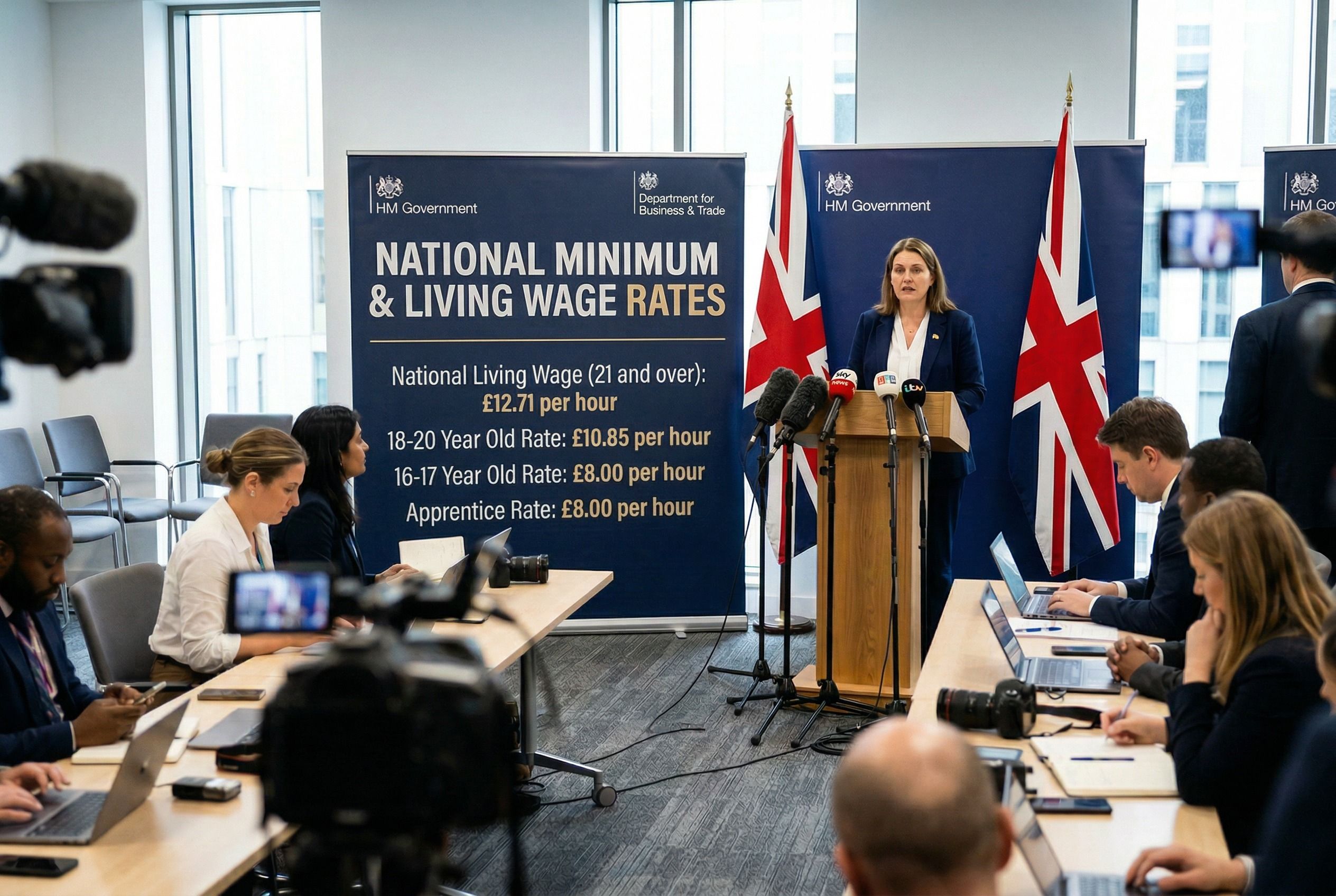
Today, 1 April 2026, the new National Minimum Wage (NMW) and National Living Wage (NLW) rates come into force across the UK.
If you employ staff, this is a change you need to act on straight away. From 1 April 2026, the National Living Wage for workers aged 21 and over rises to £12.71 per hour, with higher statutory minimums also applying to 18 to 20 year olds, 16 to 17 year olds, apprentices and the accommodation offset.
The government has accepted the Low Pay Commission's recommendations in full for 2026. The new rates from 1 April 2026 are as follows:
- National Living Wage (21 and over): £12.71 per hour, up from £12.21.
- 18-20 Year Old Rate: £10.85 per hour, up from £10.00.
- 16-17 Year Old Rate: £8.00 per hour, up from £7.55.
- Apprentice Rate: £8.00 per hour, up from £7.55.
- Accommodation Offset: £11.10 per day, up from £10.66.
The largest percentage increase is for 18 to 20 year olds, whose minimum rate rises by 8.5 per cent, while the main National Living Wage rate for workers aged 21 and over rises by 4.1 per cent. Across all age bands, these changes are designed to protect lower‑paid workers from the impact of inflation while keeping increases at a level that most employers can plan for.
For a full‑time employee working 37.5 hours per week on the National Living Wage, the new annual gross pay from April 2026 is £24,769.50. That compares with £23,809.50 at the previous £12.21 rate, so the annual increase in gross pay is £975 per employee before taking account of employer National Insurance and pension contributions. For a business employing five full‑time workers on the National Living Wage, that translates into an additional direct wage cost of around £4,875 per year, again before on‑costs are factored in.
If you employ 18 to 20 year olds, the cash increase is also significant. At the new rate of £10.85 per hour, a full‑time worker on 37.5 hours per week would earn £21,157.50 per year, compared with £19,500.00 under the previous £10.00 rate. That is an annual rise of £1,657.50 for each full‑time worker in that age band.
The accommodation offset is particularly important for sectors such as hospitality, agriculture and care, where providing accommodation is common. From 1 April 2026 the daily accommodation offset is £11.10, equivalent to £77.70 per week. If you charge more than this amount, the excess has to be treated as if it were deducted from the worker's pay for minimum wage purposes. This can easily bring a worker's effective hourly rate below the legal minimum if the level of rent is not checked against the new offset.
Before running your April payroll, it is sensible to review a few key areas. First, make sure your payroll software, timesheets and salary records are updated so that the new minimum wage rates apply from 1 April 2026. Pay particular attention to workers currently paid at or just above the old minimum rates, as small gaps can disappear once the new statutory minimums are applied. It is also worth reviewing any employees whose pay is set by reference to the minimum wage in their contract to ensure the wording still works as intended.
If you provide accommodation, check what you currently charge against the new £11.10 per day offset and consider whether any adjustments are needed to avoid underpaying the minimum wage once the offset has been applied. Where apprentices are concerned, make sure you are applying the correct rate for their age and stage of apprenticeship and that the right rate is triggered when they move into a new band.
Another important point is how age‑related rate changes work in practice. For minimum wage purposes, the rate that applies depends on the worker's age at the start of the pay reference period. When a worker has a birthday that moves them into a higher age band, the higher rate normally applies from the first full pay reference period starting on or after that birthday, not necessarily on the birthday itself. This means it is essential that payroll systems track dates of birth correctly and can show how the pay reference period has been defined if HMRC asks for evidence.
Getting the minimum wage wrong, even by a small amount, can be costly. HMRC has powers to require employers to repay arrears going back up to six years and to issue financial penalties. The policy on enforcement provides for penalties of up to 200 per cent of the total underpayment, subject to a minimum of £100 and a maximum of £20,000 per worker, although penalties can be reduced if arrears and part of the penalty are paid promptly. Employers who fail to pay the minimum wage may also find themselves publicly named on government lists, which can carry reputational as well as financial consequences.
With that in mind, it is well worth spending a little time now reviewing your payroll settings, accommodation arrangements and record‑keeping so that you can show, if asked, that every worker is being paid at least the correct National Minimum Wage or National Living Wage rate from April 2026 onwards.